They’re easy to measure, easy to compare, and easy to market.
But in simulation, high FPS alone does not guarantee accuracy.
What matters just as much—often more—is input latency.
Short answer
Frame rate describes how often images are displayed.
Input latency describes how quickly the system responds to user or sensor input.
In simulation, low input latency is often more important than high FPS.
What frame rate actually measures
Frame rate measures how many frames are rendered per second.
It reflects visual smoothness, not responsiveness.
A simulator can run at high FPS
while still reacting slowly to input.
What input latency actually measures
Input latency is the delay between an action
and the system’s response.
This includes:
- Controller or sensor input
- CPU processing and scheduling
- Physics and simulation updates
- Rendering and display output
Every stage adds time.
Why simulators care more about latency than games
Many games hide latency behind animations or visual effects.
Simulators cannot.
Simulation software relies on:
- Precise timing
- Real-time physics
- Synchronized visual and physical feedback
Even small delays can affect realism and accuracy.
How high FPS can still feel wrong
It’s possible to run a simulator at 120 or 144 FPS
and still experience delayed or inconsistent response.
This often happens when:
- CPU scheduling is interrupted
- Background processes delay input handling
- Frame pacing is inconsistent
The result is smooth visuals with poor control feedback.
The input latency chain
Input latency is cumulative.
Delays add up across the entire system.
A simplified latency chain includes:
- Input device or sensor capture
- Operating system scheduling
- Simulation and physics processing
- Rendering and display output
Improving only one link rarely solves the problem.
Why hardware upgrades don’t always fix latency
Faster GPUs often improve FPS.
They don’t automatically reduce input latency.
Latency issues are frequently caused by:
- CPU bottlenecks
- Driver behavior
- Background system activity
- Synchronization delays
This is why high-end hardware can still feel unresponsive in simulators.
Multi-display and VR increase latency sensitivity
Multi-screen and VR setups add complexity.
Synchronization requirements and frame pacing become stricter.
In these environments:
- Latency is more noticeable
- Inconsistent timing breaks immersion
- High FPS alone is not enough
Why latency issues worsen over long sessions
Over time, thermal behavior, background processes,
and scheduling changes can increase latency.
This is why simulators may feel responsive at startup
and less accurate after extended use.
What simulator systems should optimize for
Simulator PCs should focus on responsiveness, not just frame rate.
Key priorities include:
- Low and consistent input latency
- Stable CPU scheduling
- Predictable frame pacing
- Minimal background interference
Final thought
Frame rate affects how a simulator looks.
Input latency affects how it feels.
In simulation, accuracy comes from timing,
not just speed.
Simulator Platforms We Support
RBS systems are designed for the most common simulator platforms used today.
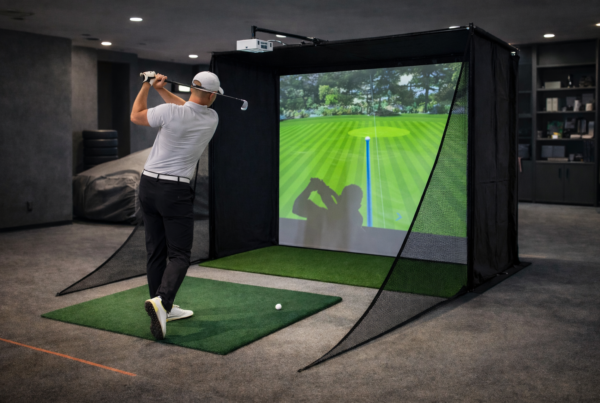
Golf simulators
TrackMan · Uneekor · Foresight
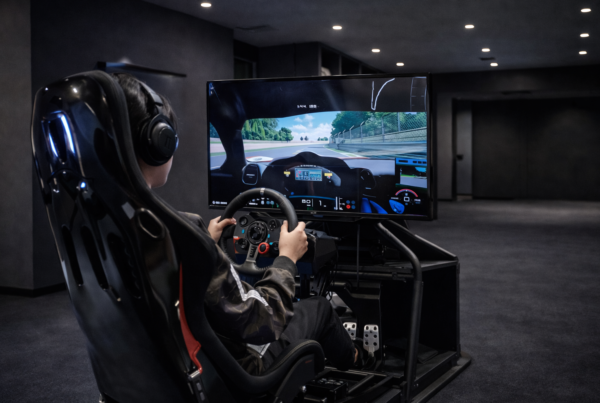
Racing simulators
iRacing · Assetto Corsa · rFactor
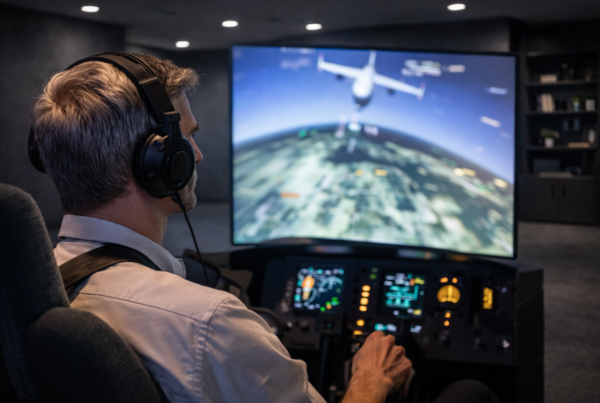
Flight simulators
MSFS · X-Plane · Prepar3D