But in simulation, peak FPS rarely tells the full story.
What actually defines simulator performance is not how high the frame rate can spike,
but how consistently frames are delivered over time.
Short answer
Frame consistency matters more than peak FPS because simulators rely on predictable frame timing.
Even small variations in frame delivery can affect realism, comfort, and input accuracy.
What peak FPS really measures
Peak FPS represents the highest frame rate a system can achieve under ideal conditions.
It usually appears during light scenes, short bursts, or benchmark-style scenarios.
Peak FPS is useful for:
- Comparing raw GPU capability
- Marketing performance numbers
- Short gaming sessions with variable load
But peak FPS does not describe how a system behaves under sustained, real-world simulation load.
What frame consistency actually means
Frame consistency refers to how evenly frames are delivered over time.
It is less about the average number and more about the variation between frames.
A system with lower peak FPS but stable frame timing often feels smoother
than a system with higher peak FPS and irregular delivery.
Why simulators are sensitive to frame timing
Simulation software runs continuous calculations for physics, telemetry,
and real-time input processing.
Unlike many games, simulators often:
- Operate in steady-state load conditions
- Process real-time sensor or control input
- Synchronize visuals with physical systems or tracking data
When frame delivery becomes inconsistent, these systems lose synchronization.
Micro-stutter vs visible FPS drops
Large FPS drops are easy to notice.
Micro-stutter is more subtle and often more damaging.
Micro-stutter occurs when:
- Frame times fluctuate unpredictably
- Frames arrive unevenly despite high average FPS
- Thermal or power limits cause momentary slowdowns
In simulators, micro-stutter can disrupt motion perception,
timing-sensitive input, and overall realism.
Latency and input accuracy
Frame consistency directly affects input latency.
When frame timing varies, the delay between physical input
and visual response becomes unpredictable.
This matters especially in:
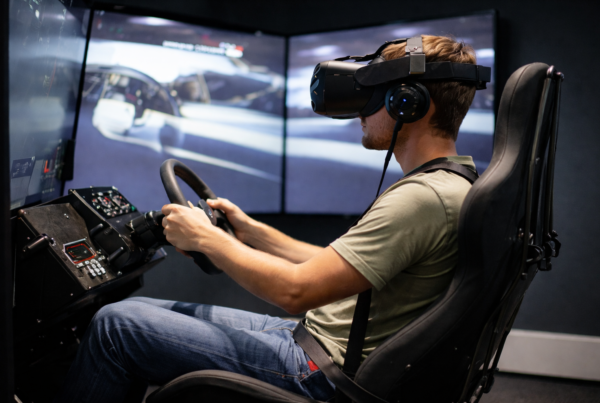
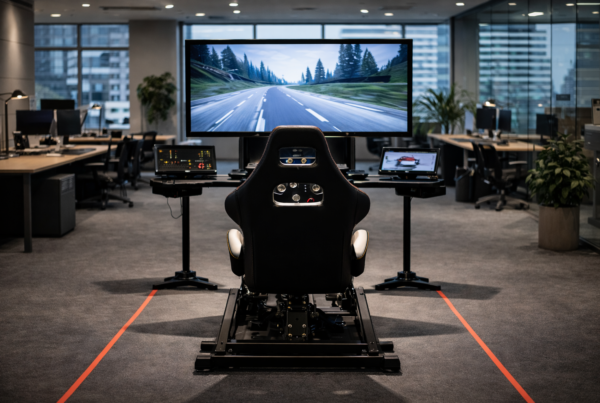
- Racing simulators
- Flight simulation
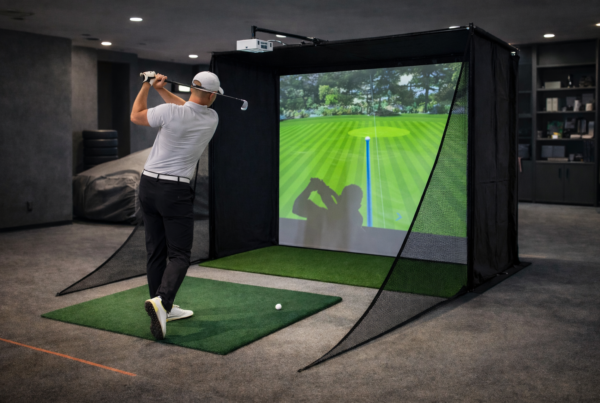
- Golf and sports simulators using camera or sensor tracking
Consistent frames produce consistent feedback.
Multi-display and VR amplify the problem
Triple screens, ultra-wide projections, and VR headsets place strict demands on frame timing.
These systems often require synchronized frame delivery to avoid discomfort or visual artifacts.
In VR especially, inconsistent frame timing can lead to:
- Motion discomfort
- Perceived instability
- Reduced immersion
High peak FPS does not compensate for inconsistent pacing.
Thermal behavior affects frame consistency
Sustained simulation workloads expose thermal limits gradually.
As temperatures rise, boost behavior changes, clocks fluctuate,
and frame delivery becomes less predictable.
This is why systems designed only for benchmarks
often show performance drift during long simulation sessions.
Why gaming performance metrics fall short
Traditional gaming metrics focus on:
- Average FPS
- Peak FPS
- Short benchmark runs
These numbers rarely reflect sustained frame stability.
In simulation, consistency matters more than brief moments of high performance.
What simulator systems should optimize for
Simulator PCs should be designed around predictable behavior, not headline numbers.
Key priorities include:
- Stable frame times over long sessions
- Thermal equilibrium under sustained load
- Consistent power delivery
- Quiet, non-intrusive cooling behavior
Final thought
Peak FPS looks impressive on paper.
Frame consistency defines how a simulator actually feels.
In simulation, smoothness is not about how fast a system can go for a moment,
but how reliably it performs hour after hour.
Simulator Platforms We Support
RBS systems are designed for the most common simulator platforms used today.
Golf simulators
TrackMan · Uneekor · Foresight
Racing simulators
iRacing · Assetto Corsa · rFactor
Flight simulators
MSFS · X-Plane · Prepar3D